Move-in Special
Get Up to 2.5 Months Free Base Rent!*
*14 month or longer lease term required. Other costs and fees excluded. See leasing agent for more information.
Woodley Park is one of Northwest DC’s most distinctive neighborhoods, shaped by early 20th-century architecture, streetcar-era growth, and an unusually close relationship with Rock Creek Park. For residents, the area’s history is visible in everything from the apartment buildings along Connecticut Avenue to the wooded ravines that frame the western edge of the neighborhood.
The neighborhood traces its name to Woodley House, an early 19th-century estate built by Philip Barton Key. Over time, the surrounding land was subdivided into residential streets that would eventually form today’s Woodley Park. Much of this early evolution is documented in the city’s historic district designation, which outlines the neighborhood’s development between 1905 and 1938.
Woodley Park’s transformation accelerated with the extension of the Connecticut Avenue streetcar line in the early 1900s. Transit access turned the area into an “uptown” residential enclave, attracting new apartment houses, hotels, and commercial buildings. This pattern — density built along a transit spine, backed by quieter residential streets — remains central to the neighborhood’s layout today.
Many of the apartment houses and hotels built during this period reflect the work and influence of renowned developer Harry Wardman, whose projects across the city emphasized livable floor plans, generous windows, and brick-and-stone detailing. While not every building in Woodley Park is a Wardman property, his architectural approach shaped the character of the entire Connecticut Avenue corridor. Background on his impact throughout DC can be found through the city’s historical documentation of the Wardman era.
Today, Woodley Park is recognized as a cohesive historic district defined by its brick façades, pre-war apartment buildings, and broad sidewalks. The DC Office of Planning’s overview of the Woodley Park Historic District outlines the neighborhood’s consistent architectural vocabulary: mid-rise residences, early 20th-century hotels, embassies, and tree-lined side streets positioned above the Rock Creek valley.
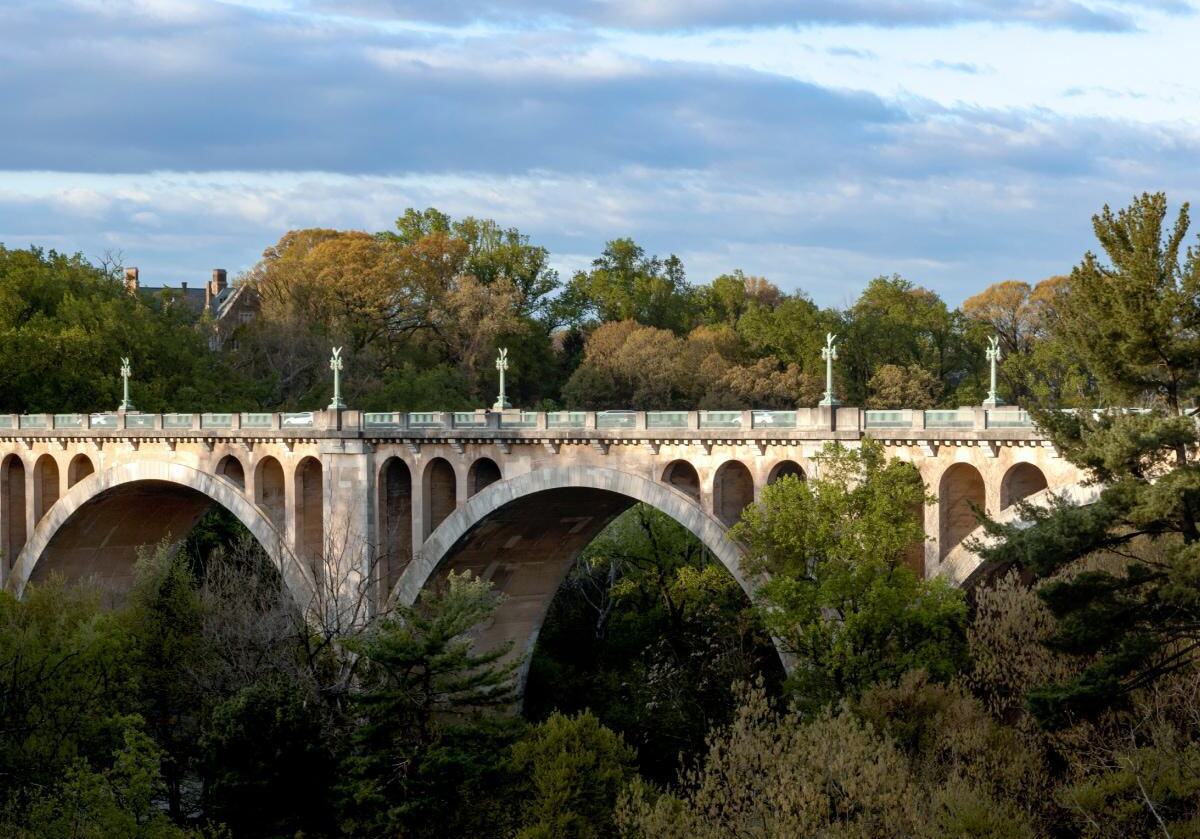
At the neighborhood’s southern edge, the monumental Taft Bridge carries Connecticut Avenue over Rock Creek Park. Its concrete arches and decorative lions mark one of DC’s most iconic gateways. More on its history is available through the city’s documentation of the Taft Bridge, which is listed on the National Register of Historic Places.
Woodley Park’s western boundary meets some of the oldest and most protected forest in the city. The valley, trail network, and picnic areas of Rock Creek Park sit just below the ridgeline, providing everyday access to long-distance trails, car-free weekend routes on Beach Drive, and deep wooded ravines that feel far removed from city streets.
This adjacency shapes the neighborhood’s identity: residents step from dense apartment blocks directly into a national park.
One of the area’s most defining landmarks is the Smithsonian National Zoo, which occupies 163 acres along Rock Creek and connects directly to Connecticut Avenue. Founded in 1889, the Zoo functions as both a regional attraction and a daily amenity for Woodley Park — with internal walkways, scenic overlooks, and open areas residents treat like public parkland.
A Eshort walk north of Woodley Park, the Tregaron Conservancy preserves a historic estate landscape of winding trails, ponds, and woodlands. The site provides a quieter complement to Rock Creek Park and reflects the broader pattern of early 20th-century estates and institutional campuses that once lined this part of Washington.
The surrounding area includes several notable historic properties, such as the Woodrow Wilson House in nearby Kalorama. Though outside the Woodley Park boundary, these homes and museums provide context for the social and architectural history of upper Northwest DC.
For residents of Aerie and Zephyr, the neighborhood’s history is not abstract — it’s visible in the scale of the buildings, the consistency of the streetscape, the presence of the Zoo, and the immediate access to some of the city’s largest green spaces. Woodley Park’s combination of historic architecture, transit-oriented development, and natural landscapes continues to define the lived experience of the neighborhood today.